Overview
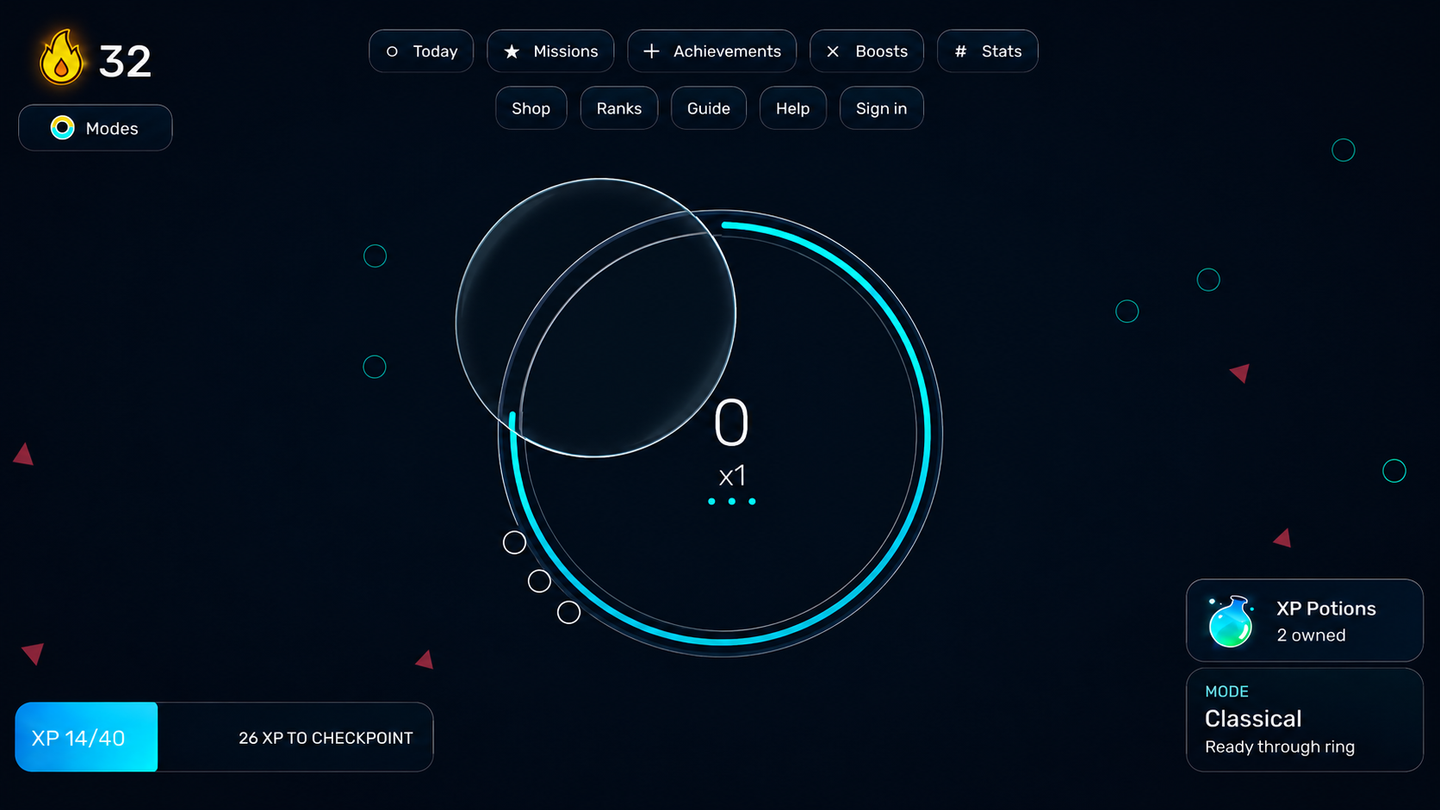
Glimpse is an original browser game built around a movable lens rendered through WebGL. The lens is not merely a visual filter placed over conventional gameplay; it is part of the game’s underlying interaction.
The central mechanic is supported by adaptive pacing, progression, rewards, unlocks and customization, turning one unusual interaction into a broader product rather than a single-effect prototype.
The core concept
Most visual effects change how a game looks while leaving its rules untouched. Glimpse was designed around the opposite idea: perception itself changes the meaning and outcome of player actions.
The player must therefore understand both the visible scene and the lens through which it is being interpreted. Moving the lens becomes a gameplay decision rather than a camera adjustment.
How the system works
The game maintains its simulation separately from the final WebGL output. The lens layer reads and transforms the rendered scene while remaining coordinated with the gameplay state.
A game director works alongside spawn and progression systems to shape pacing, challenge and recovery. The surrounding architecture includes storage, statistics, rewards, achievements, missions, unlocks and leaderboards.
These systems are separated into focused modules so that progression and product features do not become entangled with the core render loop.
Interaction and product design
The interface must teach an unfamiliar mechanic without overwhelming the first session. Tutorial guidance, overlays, visible state changes and restrained controls establish how the lens affects play.
Progression and reward systems then give the mechanic a longer-term structure. Unlockable lenses, backgrounds, particles and effects provide visual variety while remaining connected to the central rendering system.
The result is designed to feel like one product: gameplay, customization, progression and interface language support the same visual identity.
Engineering decisions
WebGL rendering, simulation state and interface overlays must remain synchronized while occupying different visual layers.
Performance is treated as part of the architecture through dedicated runtime configuration, performance handling, viewport management and preloaded thumbnail atlases.
The codebase separates game direction, spawning, rendering, rewards, progression, cosmetics and interface responsibilities. That modularity makes a large browser project easier to extend and reason about than a single monolithic game script.
What the project demonstrates
Glimpse demonstrates the ability to expand a distinctive technical mechanic into a larger, maintainable browser product.
It brings together rendering, state coordination, adaptive systems, progression, persistent data and customization while preserving one recognizable central idea.
Technical highlights
WebGL lens pipeline
The rendered scene and lens output are handled as coordinated visual layers.
Mechanic-driven rendering
The visual transformation is directly connected to gameplay meaning.
Adaptive game direction
Pacing, challenge and recovery are coordinated by dedicated systems.
Progression architecture
Rewards, missions, achievements and unlocks extend the core session.
Modular customization
Lenses, backgrounds, particles and effects use separate reusable systems.
Product-scale organization
Rendering, gameplay, progression and interface concerns remain separated.