Overview
The Choir Management Platform is a custom internal web application built to support the recurring work of a choir. It combines rehearsal material, internal information, member features and administrative tools in one responsive environment.
The application is structured around how members actually use it. Current repertoire is separated from the full archive. Practice material is organized by song, vocal part and recording type. Internal notices, member information and choir-wide messages remain behind controlled access. Administrators can maintain the content without editing source code or relying on a developer for ordinary updates.
Rather than placing unrelated features beside one another, the platform connects them through one information structure and one role-aware interface. Members receive a focused everyday experience, while administrators and the owner receive the additional controls required by their responsibilities.
The organizational need
A choir’s internal work does not fit neatly inside a public website.
Members need quick access to current rehearsal material, but the same environment may also contain contact information, internal announcements, copyrighted documents, practice recordings and administrative controls. Distributing those resources through separate folders, email threads, public pages and informal links makes it harder to know which material is current and who should be able to change it.
The platform therefore needed to solve two problems at once.
First, it had to reduce friction for ordinary members. Repeated tasks such as finding this week’s songs or opening the correct vocal-part recording should require as little navigation as possible.
Second, it had to preserve clear privacy and responsibility boundaries. Fast access to rehearsal resources should not automatically expose member-only information or administrative actions.
The result needed to feel like one coherent product rather than a collection of protected pages.
Users and access
The platform separates access according to what a person needs to do.
A limited shared-access path provides straightforward entry to selected rehearsal material and internal notices. Named member accounts unlock the member directory, choir-wide messages and personal account settings. Administrators can maintain repertoire, files, groups and bulletin content. A separate owner role controls higher-impact member and permission changes.
This layered model keeps the ordinary member interface focused. Members are not presented with administrative complexity, and content controls are not merely hidden visually: protected actions are also checked by the server before they are performed.
Authentication and authorization are treated as different responsibilities. Authentication establishes who the person or session is. Authorization determines which information and actions that session may access.
The public case study intentionally generalizes the detailed access rules. The important product decision is that the platform supports both convenient everyday entry and more accountable named access without treating every visitor as the same type of user.
The product approach
I organized the platform around the choir’s own mental model rather than around generic software categories.
Members see current repertoire, the full song archive, internal notices, people, messages and their own account. Songs are grouped in a way that reflects how the organization categorizes its material. The current-song view removes the distraction of the complete archive when members only need the pieces being rehearsed now.
Complex workflows use progressive disclosure. Account settings are divided into focused sections. Song creation is staged rather than presented as one enormous upload form. Administrative controls appear only for roles that can use them.
The architecture follows the same principle. It uses server-rendered pages for dependable navigation and forms, then adds focused JavaScript where interaction benefits from it: searching, custom selectors, upload workflows, message behaviour, drag-based organization and synchronized playback controls.
This keeps the application lean while still allowing the most important workflows to feel purpose-built.
What I built
The completed platform covers the full path from member access to content maintenance.
Repertoire and current material
The song archive organizes the choir’s complete material into groups, while a separate active view highlights the repertoire currently in use.
Each song can contain several kinds of protected resources, including practice audio, sheet music and lyric documents. Search and grouping make a growing library easier to navigate without exposing the underlying file structure to members.
Member accounts
Named accounts support email verification, sign-in, password recovery and personal settings.
Members can maintain their own account information and vocal-part assignment. Account-only areas include the directory and choir-wide message feed, keeping those features separate from limited shared access.
Internal information
The bulletin board gives the choir a protected place for current notices and document attachments.
Posts can be highlighted, archived and managed by authorized roles. The implementation also supports date-aware information, while the public case study avoids presenting it as a complete calendar system.
Member communication
The message area provides a lightweight organization-wide feed for named members.
Messages have per-member read state and an unread indicator in the main navigation. The feature is intentionally described as a shared internal feed rather than direct messaging or group conversation.
Administration
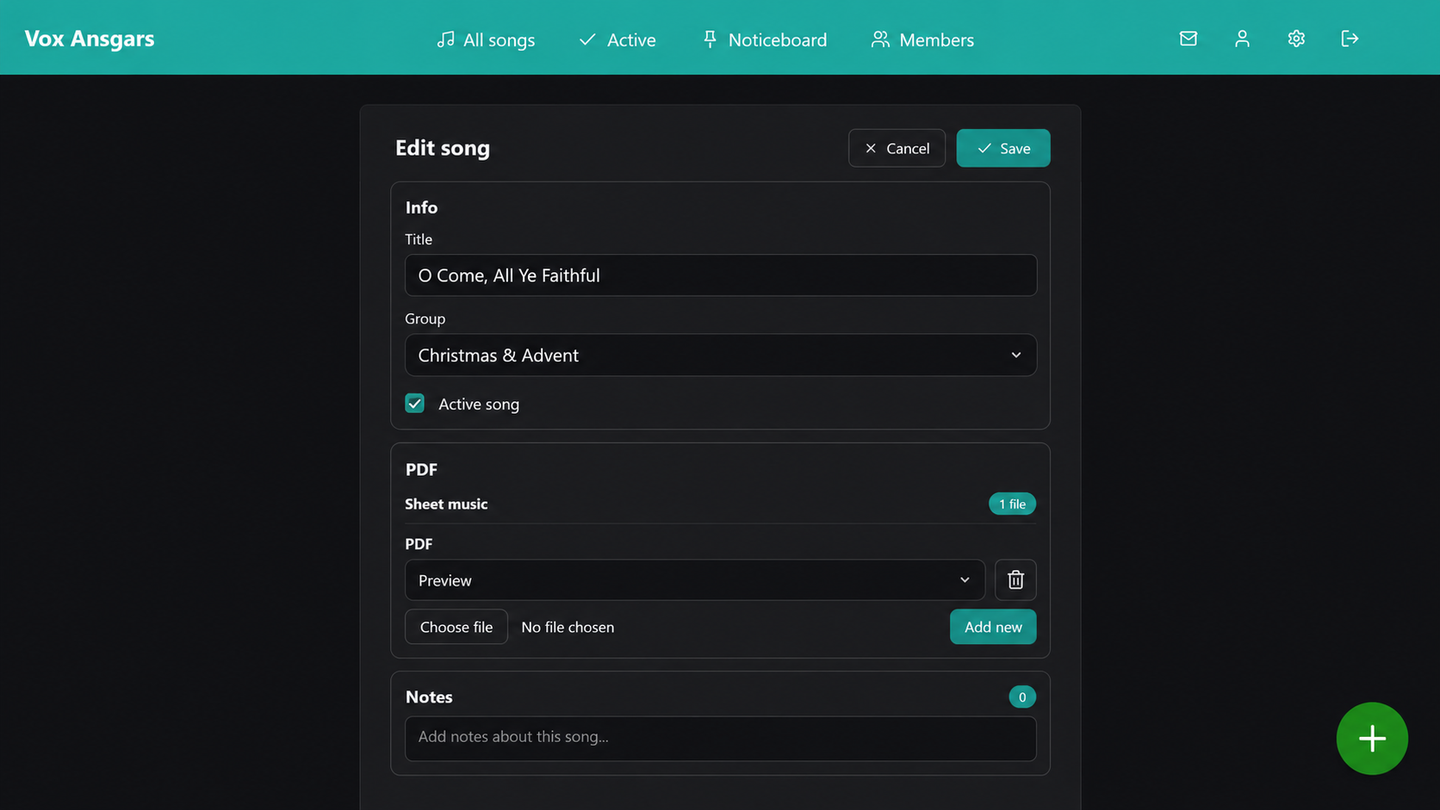
Administrators can add and edit songs, upload or replace resources, manage groups, mark current material and maintain bulletin content.
The owner receives additional tools for member roles and other high-impact account responsibilities. Sensitive actions use additional confirmation and server-side permission checks.
Responsive member experience
The interface is designed for repeated use on both phones and computers.
Navigation remains available through a compact sticky header. Lists and forms collapse into practical mobile layouts, media controls remain usable on smaller screens and administrative flows account for touch targets and safe-area spacing.
The practice workflow
The most distinctive part of the application is the song-practice experience.
A normal file archive might contain a collection of audio files and PDFs. This platform understands why those files exist. Practice recordings are organized by vocal part and can include different mix variants, allowing a member to choose the version most useful for learning.
The song page brings those resources together in one place:
- full-ensemble and voice-specific audio;
- alternate practice mixes where available;
- sheet-music documents;
- lyric documents;
- protected streaming and download;
- one playback-speed control shared across the page.
Changing the speed updates every audio player consistently. The control supports a broad practice range while preserving pitch where the browser allows it. Audio is streamed with byte-range support, so members can seek within longer recordings without downloading the complete file before playback begins.
This is what turns the project from a protected document library into a tool designed for rehearsal.
Administration
The platform needed to remain maintainable after delivery.
Song creation is divided into understandable stages: establishing the song, adding documents, adding audio and assigning the organizational context. Optional steps can be skipped, and existing songs can later be updated without recreating them.
Administrators can organize repertoire into groups, change which pieces are active and maintain internal notices. The owner can search for members and manage higher-level roles through a separate interface.
Several safeguards reduce the chance of accidental changes:
- permission checks are performed on the server;
- forms use request validation;
- destructive operations use confirmation;
- the most sensitive owner actions require the current password again;
- important multi-record changes use database transactions where appropriate.
The goal is not to expose every possible system operation. It is to give authorized non-developers the controls needed for ordinary maintenance while keeping higher-impact responsibilities clearly separated.
Privacy and reliability
Privacy is part of the product structure because the platform handles internal organizational information.
The public website and private member platform are deliberately different environments. Internal content is protected through session-based access, and named-account features require a verified account. Interface permissions are backed by server-side checks rather than relying only on hidden buttons.
The implementation includes password hashing, session renewal after sign-in, email verification, expiring recovery links, neutral password-recovery responses, request-forgery protection, prepared database statements, escaped output and file-type validation.
These are layered engineering practices, not a claim of formal certification. The project has not been presented as independently audited, fully compliant or immune to risk.
The application also includes practical reliability measures:
- protected file requests are checked against stored content metadata;
- high-impact owner operations require additional verification;
- account and ownership changes use coordinated database operations;
- file migrations were designed with controlled and dry-run-aware workflows;
- ordinary member pages avoid exposing administrative actions.
Because this is a private client platform, identifying interface content, member data and security-sensitive implementation details are intentionally omitted from the case study.
Technical architecture
The platform uses a deliberately lean server-rendered architecture.
PHP handles routing, sessions, validation, database operations and page rendering. MySQL stores accounts, roles, repertoire metadata, messages, read state and internal content. PDO prepared statements provide the database layer. PHPMailer supports account verification and password recovery. Vanilla JavaScript adds focused interaction without requiring a large client-side framework.
This architecture fits conventional shared hosting and keeps the operational surface relatively small. There is no separate frontend application, API gateway or JavaScript state framework to maintain.
A representative request follows a straightforward path:
- the browser sends a form or page request;
- the application checks the current session and role;
- submitted data is validated;
- protected changes verify the request token and any additional authorization;
- prepared database operations read or update the required records;
- the server returns the next rendered state.
Large audio files are served with range support so playback and seeking remain practical. Static and page-specific JavaScript are loaded only where they are needed.
The architecture is compact rather than simplistic: its value lies in coordinating access, content, media and administration with low deployment overhead.
The result
The finished platform gives the choir one coherent place for its recurring internal work.
Members can move from current repertoire to the correct practice recording or document without navigating a general-purpose file system. Internal notices, member information and messages remain inside the same familiar environment. Administrators can maintain the material and organizational structure through interfaces designed for those tasks.
The result is not a generic website with a login screen added to it. It is an application shaped around the choir’s operating model:
- current material is separated from the complete archive;
- practice resources understand vocal parts and recording variants;
- private member features require named access;
- content administration is separated from member and owner responsibilities;
- the interface remains practical on phones as well as desktop screens.
No quantified operational result is claimed publicly because usage figures, time savings and client outcomes have not been approved for publication. The case study instead demonstrates the implemented product, the reasoning behind it and the engineering required to make it dependable.
My role
I was responsible for translating the organization’s workflows into a usable private platform and implementing the product across the frontend and backend.
The work included:
- structuring the member and administrative experiences;
- designing role-aware navigation and permissions;
- implementing account registration, verification, sign-in and recovery;
- modelling repertoire, files, messages, read state and internal content;
- building the song-practice and synchronized playback experience;
- creating the administration workflows;
- developing responsive layouts and focused browser interactions;
- integrating database, file storage and transactional operations;
- preparing the application for conventional shared hosting;
- handling migration and ongoing maintenance considerations.
The case study deliberately describes responsibility at a product and system level without exposing private client data or deployment details.
Technical highlights
Layered access
Limited shared access, verified member accounts, content administrators and an owner role keep ordinary use simple while separating higher-impact responsibilities.
Voice-specific practice
Multiple recording slots, alternate practice mixes, protected documents and synchronized playback speed turn a file archive into a practical rehearsal tool.
Account lifecycle
Password hashing, email verification, expiring recovery links, neutral reset responses and renewed sessions support safer member self-service.
Operational administration
Staged uploads, repertoire grouping, current/archive states, bulletin publishing and confirmation flows allow authorized non-developers to maintain the system.
Lean delivery
Server-rendered PHP, PDO and MySQL, vanilla JavaScript and responsive CSS provide a focused application without a heavy framework stack.
Media-aware engineering
Protected content metadata, byte-range audio streaming and migration-minded file organization support a substantial library of rehearsal resources.
Honest limitations
The Choir Management Platform is a focused internal application, not a complete enterprise collaboration suite.
Important boundaries include:
- the message feature is one organization-wide feed rather than direct or group messaging;
- schedule information is attached to internal notices rather than provided through a full recurring calendar;
- the platform does not include attendance management, push notifications or a broad workflow-approval system;
- long message histories and large member lists do not currently use pagination;
- formal security, privacy and accessibility audits are not documented;
- automated test coverage is limited and important workflows still rely on manual verification;
- the application is designed for a specific organization and conventional hosting rather than claimed as a massively scalable multi-tenant product;
- the private application, source code and identifying data cannot be opened from this public case study.
These limits do not weaken the case study. They clarify the product’s intended scope and prevent focused functionality from being presented as something broader than it is.